
Why 70 Civil Society Groups Are Challenging Coastal Highway Route Through Akwa Ibom’s Stubb’s Creek

By Ekemini Simon
A broad coalition of civil society organisations in Nigeria has issued a call on the both the federal government and government of Akwa Ibom State to halt the proposed routing of the Lagos–Calabar Coastal Highway through Stubb’s Creek Forest Reserve in Akwa Ibom State.
The CSOs numbering 70 under the umbrella of “Save Stubb’s Creek Coalition” argued that the project, as currently conceived, threatens to erase one of Nigeria’s most ecologically significant protected areas and deepen the Niger Delta’s already acute climate vulnerability.
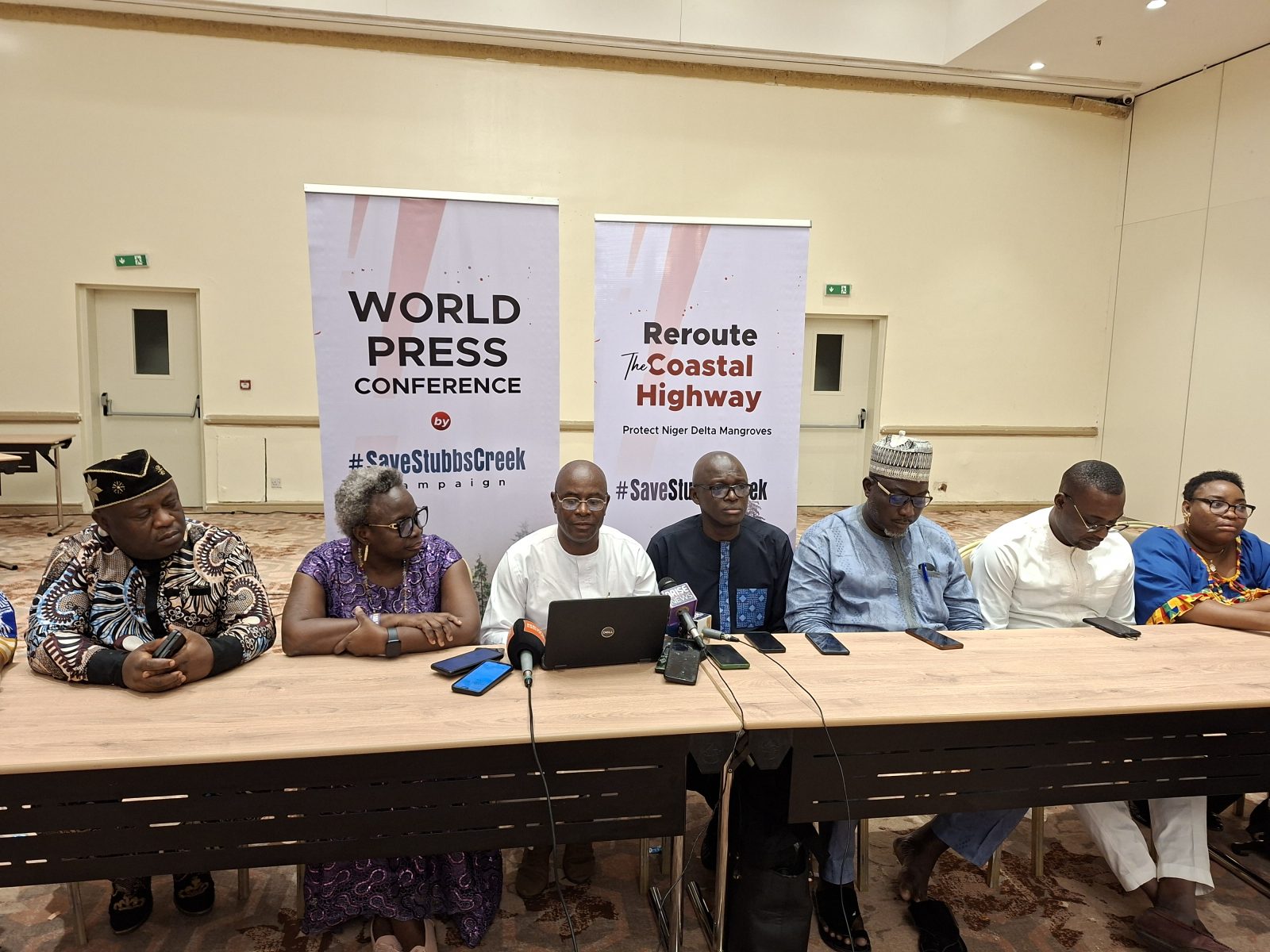
The warning was delivered during a World press conference held on Wednesday at the Abuja Continental Hotel, FCT where the Executive Director of Neighbourhood Environment Watch Foundation, Kelechuwu Okezie, read a strongly worded press statement on behalf of the national and international organisations spanning human rights, environmental justice, governance reform and accountability advocacy.
The Coalition described the Stubbs Creek forest reserve as a biodiversity hotspot and a critical natural defence system for coastal communities in Akwa Ibom and the wider Niger Delta.
Stubb’s Creek history and function
Stubb’s Creek is a legally gazetted forest reserve established under Forest Reserve Order No. 45 of 1930 during the colonial era. For nearly a century, it has been recognised as a protected ecological asset, comprising mangrove and freshwater forest systems that support thousands of plant and animal species, including rare and endangered ones.
Beyond biodiversity, the reserve performs functions that are increasingly vital in Niger Delta fragile ecosystem. This includes coastal protection against erosion, flood control, carbon sequestration, fisheries breeding grounds, and the sustenance of forest-dependent and indigenous communities whose livelihoods are dependent on this environment.
The Civil society groups said that driving a major coastal highway through such a fragile zone would cause irreversible damage ranging from large-scale deforestation and hydrological disruption to biodiversity collapse and the erosion of community livelihoods with consequences that far outweigh the short-term gains of infrastructure speed and symbolism.
Spectre of de-reservation
What has heightened anxiety is the Akwa Ibom State Governor’s public declaration that the Federal Government have been given the right of way for the construction of the coastal highway that will crisscross the forest.
Under Volume III, Cap 52 of the Laws of Akwa Ibom State 2022, de-reservation is legally possible when notice is issued by the government. However, civil society organisations insist it is a grave decision that must meet strict procedural, environmental and participatory standards.
Global experience, they said shows that downsizing or degazetting forest reserves often leads to rapid, irreversible environmental loss. Once legal protection is lifted, forests rarely recover.
The groups argue that the de-reservation argument collapses under scrutiny because the highway can be rerouted. “Portions of the Lagos–Calabar Coastal Highway have already been realigned in other states, demonstrating that alternative routes are feasible when ecological and social considerations are taken seriously”, they said.
The civil society groups say the timeline of the project does not allow for the kind of meaningful public consultation, free prior informed consent, and access to information required under international environmental and human rights norms hence the government should simply reroute the project.
Landscape already under siege
Stubb’s Creek is not existing from a position of ecological strength. Civil society organisations point to cumulative damage from previous and ongoing projects within and around the reserve.
An abandoned 2017 superhighway project and the ongoing BUA refinery development have already opened up large swathes of the forest to logging and encroachment. These activities, they say, have left glaring ecological scars and accelerated deforestation.
The 2016 Environmental and Social Impact Assessment (ESIA) for the BUA refinery identified severe potential impacts on the environment and on communities dependent on the forest, alongside commitments to mitigation measures. Nearly a decade later, civil society groups say there is no evidence that these mitigation actions have been implemented.
Introducing another major infrastructure project into this already stressed ecosystem, they insist risks triggering a cascade of degradation from which the forest may never recover.
Law on paper, development in practice
Beyond environmental science, the controversy raises legal questions.
Section 20 of Nigeria’s 1999 Constitution (as amended) obliges all levels of government to “improve the environment and safeguard the water, air and land, forest and wildlife of Nigeria.” Similarly, the Environmental Impact Assessment Act of 1992 requires that projects likely to have significant environmental effects undergo a thorough and public EIA process before approvals or land-altering activities commence.
Civil society organisations say evidence from the Federal Ministry of Environment indicates that the ESIA process for the highway segment affecting Stubb’s Creek only began in January 2026 long after approvals and public pronouncements on the highway’s alignment.
The Coalition explained that advancing or approving the project before completing a comprehensive ESIA undermines the spirit and letter of Nigerian law, raising troubling questions about transparency, due process and regulatory capture.
“Stubb’s Creek Beyond narrow ownership debate”


While the Akwa Ibom State Government has cited the Land Use Act of 1978 to assert administrative control over the reserve, civil society groups insist the debate cannot be reduced to legal title.
They said “What is at stake is the reduction of complex communal rights and ecological fragility to a narrow question of ownership.”
In an era of climate crisis, development decisions carry ethical and intergenerational consequences. They note that the Niger Delta now faces threats similar to those confronting small island nations such as rising sea levels, coastal erosion, salinisation, flooding and ecosystem collapse. The group stressed that mangrove forests and wetlands like Stubb’s Creek are among the region’s strongest natural buffers against these threats.
The civil society groups insisted that sacrificing such systems for short-term infrastructure gains violates Nigeria’s international commitments on climate change and biodiversity and undermines the principle of intergenerational equity, the obligation to safeguard environmental resources for future generations.
“That a forest identified by colonial authorities nearly a century ago as worthy of permanent protection is now being positioned for sacrifice on the altar of “infrastructure” reflects a dangerous approach to development that prioritises brick, mortar, and asphalt over socio-ecological dimensions”, the statement said.
Coordinated call for restraint
The coalition makes demands. They call on the Federal Ministry of Works to immediately reroute the highway away from Stubb’s Creek and its buffer zones, publicly disclose alternative alignments, and ensure strict compliance with the EIA Act and international safeguards.
They call on the Federal Ministry of Environment to mandate and publish a cumulative ESIA covering all existing and proposed projects affecting the reserve; enforce the precautionary principle, including a temporary halt to land clearing where safeguards are absent; and guarantee transparent public participation through open consultations and independent review mechanisms.
For the Akwa Ibom State Government, they said ” We call on the Akwa Ibom State Government to unequivocally affirm the protected status of Stubb’s Creek Forest Reserve and refuse any land allocation or right of way approvals that permit construction within the reserve; actively engage the Federal Government and host communities to secure a lawful, environmentally responsible, and conflict-sensitive alignment for the coastal highway that respects both statutory protections and indigenous rights; and protect the rights and safety of communities and civil society actors advocating for environmental protection.”
Civil society groups insist that rerouting the Lagos–Calabar Coastal Highway is not anti-development, but rather a necessary investment in climate resilience, environmental justice and long-term economic stability.
” True development must not come at the cost of ecological collapse and heightened climate vulnerability. Protecting Stubb’s Creek is not an obstacle to development; but rather an investment in climate resilience, environmental justice, and the long-term wellbeing of present and future generations in Akwa Ibom State and the wider Niger Delta”, the statement concluded.
Among the Civil society groups include Policy Alert, Health of Mother Earth Foundation (HOMEF), Peace Point Development Foundation, Connected Development, Amnesty International Nigeria, Accountability Lab Nigeria, BudgIT Foundation, Center for Fiscal Transparency and Public Integrity, Centre for Democracy and Development (CDD) Environmental Rights Action/Friends of the Earth, Nigeria (ERA), Falana and Falana’s Chambers, Global Rights, Green Concern for Development (GREENCODE), Human and Environmental Development Agenda (HEDA Resource Centre).
Others are Human Rights Social Development and Environmental Foundation, INVICTUS AFRICA, Kebetkache Women Development & Resource Centre, Lawyers Alert among others.