


Akwa Ibom Stakeholders Demand COP30 Taskforce, Climate Change Council to Drive State-Level Action

By Unyime Okon
Climate stakeholders in Akwa Ibom State have called on the state government to immediately create a State COP30 Action Taskforce and establish a State Climate Change Council to coordinate policy domestication, climate finance access, budget reforms, community engagement, and the implementation of commitments arising from COP30 held in Belem, Brazil.
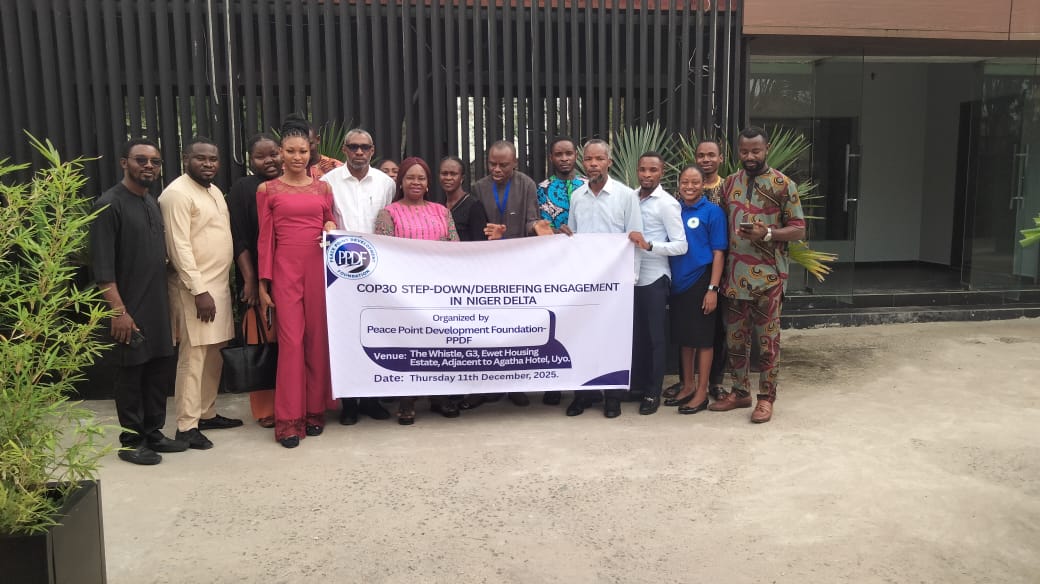
This formed the core of a communique issued in Uyo on Thursday during the COP30 Step-Down/Debriefing Engagement organised by Peace Point Development Foundation (PPDF), which brought together civil society groups, community representatives, government agencies, student movements, and the media.
The communique called on the Akwa Ibom State Government to urgently pass a state climate change law supported by clear policies and action plans that align global climate outcomes with local realities in the Niger Delta.

Participants insisted that the Akwa Ibom State Government must jointly convene pre-COP consultations with civil society and ensure that any state representative attending global climate conferences gives public accounts of their activities.
They also demanded strict adherence to Environmental and Social Impact Assessments for all government projects, the diversification of the state’s oil dependent economy, and the integration of just transition measures that give communities, workers, women, youth, fisherfolk, and other vulnerable groups a real voice in energy transition planning.
The meeting further called for structures to help sub-national governments and frontline communities access climate finance, the promotion of community-level climate education, and the use of social media by local actors to escalate environmental violations.
Participants also raised concerns about their experiences at COP30, citing difficulties in obtaining visas, high travel costs, limited opportunities for local actors to present their positions, censorship of civic materials, and what they described as militarisation at venue entrances and exits. They argued that these conditions were designed to stifle indigenous participation and silence critical voices from the Global South.
Presenting on “State-Level Climate Action: Translating COP30 Agreements into Subnational Policies,” environmental activist and journalist Ekemini Simon said Akwa Ibom needs deep institutional and governance reforms to ensure effective climate action. He stressed the establishment or strengthening of a State Climate Change Council to coordinate and integrate climate policies across all ministries and departments, drawing attention to Nasarawa State, which has already passed its Climate Change Bill. Simon said that climate responsibility must be mainstreamed across all MDAs rather than being treated as the exclusive mandate of the Ministry of Environment.
He also underscored the importance of transparency, noting that COP30’s emphasis on information integrity obligates the state to ensure open climate data, regular reporting, and inclusive decision-making processes in order to protect rural and climate-vulnerable communities.


Simon added that the government must localise the Just Transition Mechanism by involving host communities, women, youth, displaced persons, and fisherfolk in planning, while also investing in community-based adaptation programmes such as mangrove restoration, agroforestry, coastal buffers, sustainable fishing practices, and alternative livelihoods.
In his remarks, the Coordinator of Peace Point Development Foundation, Comrade Umo Isua-Ikoh, said the engagement was taking place at a defining moment for both global climate ambition and the local realities of the Niger Delta.
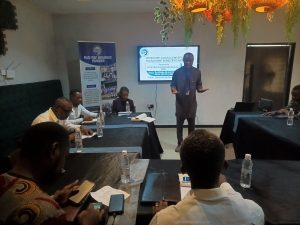
He stated that COP30’s commitments would remain meaningless if not translated into state-level actions that underpin the resilience of communities and ecosystems. “COP30 will not succeed in Nigeria if it does not succeed in the states. And the states cannot succeed if citizens, MDAs, and communities do not take ownership,” he said.
According to him, every stakeholder has a role to play, ministries, local governments, because the collective effort of all actors will determine whether Akwa Ibom can shift from being seen only as an oil-producing region to becoming one of Africa’s leading climate-resilient regions.
Isua-Ikoh insisted that with deliberate and sustained action, the global commitments made in Belem would not remain distant or abstract but could trigger a state-driven climate revolution rooted in the everyday realities of the people.