


Beyond Asphalt and Power: How Coastal Highway Through Reserve Pits Akwa Ibom’s Govt Against Laws, Science


As Akwa Ibom State throws its weight behind routing the Lagos–Calabar Coastal Highway through the Stubbs Creek Forest Reserve, a protected ecosystem of immense ecological value, serious questions arise about due process, environmental law, and the meaning of development in a climate vulnerable era. This report examines what the law says, what the government has done, and why environmental experts and civil society groups warn that sacrificing Stubbs Creek could represent an irreversible mistake.
By Ekemini Simon
The controversy surrounding Stubbs Creek Forest Reserve escalated unprecedentedly when Akwa Ibom State Governor, Mr. Umo Eno publicly dismissed objections to routing the Lagos–Calabar Coastal Highway through the reserve. Speaking at the commissioning of an ultra-modern health centre in Nduo Eduo, Eket Local Government Area, the governor described opposition from Ekid leaders as needless resistance to progress.
“Make no mistake, nobody will stop the Lagos–Calabar Coastal Highway from passing through the Stubb’s Creek Forest Reserve. It is a government reserve, and when the government decides to act in the interest of the people, it will act,” Mr Eno declared.
That statement triggered a swift response from leaders of Ekid extraction, operating under the Ekid People’s Union (EPU), who had earlier petitioned against the proposed route. Their response sought to counter what they described as a fundamental mischaracterisation of their position.
“Ekid people are not opposed to development. This must be stated clearly and repeatedly,” the group said. “We desire development in all its forms. We want roads, hospitals, schools, industries, and opportunities for our young people, just like every other community in Akwa Ibom State.”
Their objection, they insisted, was not to infrastructure itself but to “a model of development that treats host communities as inconveniences, that circumvents the law, and that ignores history and culture.” According to them, demanding compliance with due process in land acquisition is not sabotage but “a legitimate demand grounded in law and citizenship.”
Beyond legality, the Ekid leaders sounded a more disturbing warning: Stubbs Creek they said, is one of the last remaining forest ecosystems in Akwa Ibom State, crucial for flood control, biodiversity conservation, and local livelihoods. They posited that forcing major infrastructure through such a fragile ecological zone risks irreversible environmental damage and long-term economic loss.
Forest Reserved for Posterity
Stubbs Creek Forest Reserve was not preserved as a protected area for the fun of it. Its protected status dates back nearly a century. In the 1920s, colonial authorities identified the area spanning present day Eket, Esit Eket, Ibeno and Mbo Local Government Areas as one of southern Nigeria’s richest biodiversity hotspots. The forest hosts valuable hardwood species such as African mahogany, African satinwood, Afara and African walnut, alongside endangered primates including Sclater’s guenon, Mona monkey, Putty-nosed monkey and the red capped mangabey. These treasures are rare to find elsewhere.
To safeguard this ecological treasure, the colonial government enacted Forest Reserve Order No. 45 of 1930, designating Stubbs Creek as a protected reserve for biodiversity conservation, wildlife protection, water regulation and long-term ecological health. Covering about 310.8 square kilometres, the reserve was explicitly set aside for future generations.
However, nearly a century later, the very logic behind that protection is being tested.
Reserve Under Siege
On the ground, Stubbs Creek already bears the scars of repeated intrusions. A visit by TheMail Newspaper in September 2025 revealed that large portions of the forest had been cleared, raising fears that reopening the reserve for yet another major project could finish what earlier projects promised to bring developments started.
In 2017, the administration of former Governor Udom Emmanuel cleared parts of the forest for a proposed 55-kilometre superhighway linking a planned seaport in Mbo Local Government Area. The project was abandoned a year later, leaving a barren corridor through the reserve. Three years after that, additional forest land was lost to the still unfinished 200,000-barrel-per-day BUA petrochemical and refinery project.
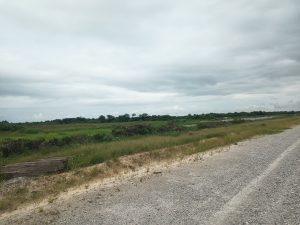
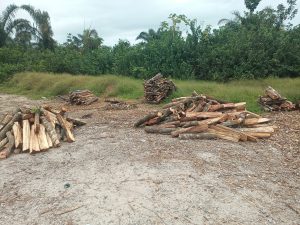
Although shrubs have begun to reclaim parts of the abandoned superhighway corridor, the damage is far from beyond the corridor. A new access road constructed for BUA’s refinery now cuts roughly six kilometres into the forest, opening previously inaccessible areas to logging. Along this road, a thriving timber market has emerged. Logs of various sizes are stacked openly for sale, while trucks, tricycles and motorcycles ferry wood out of the forest daily.
Sellers told TheMail that logging has continued largely unchecked since 2021, when the BUA access road was built. The timber is used mainly for construction and firewood, further accelerating deforestation in an already stressed ecosystem.
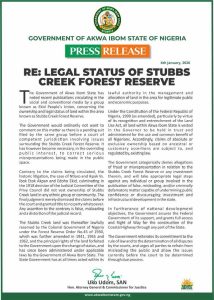
Despite these realities, the Akwa Ibom State Government is yet to show indication to reconsider rerouting the coastal highway project through this fragile ecosystem and a reserve already under siege. In a statement signed by the Attorney General and Commissioner for Justice, Uko Udom, SAN, on January 6, 2026, the government said it formally granted the Federal Government right of way through the reserve. “In furtherance of national development objectives, the Government assures the Federal Government of its support, and grants full access and Right of Way for the construction of the Coastal Highway through any part of the State,” the statement read.
What the Law Actually Says
Under Volume III, Cap 52 of the Laws of Akwa Ibom State 2022, a law enacted specifically for “the preservation and control of forests in Akwa Ibom State”, the government does possess the power to de-reserve part of the forest land. However, that power is not absolute.
Section 21 of the law stipulates that de-reservation must be formalised through a notice published in the official Gazette by the Commissioner for Agriculture. Only from the date specified in such a gazetted notice can that part of the land legally cease to be part of a forest reserve.
Legal practitioner Ekemini Udim explained that gazetting is not a symbolic gesture but a core requirement of legality. “Gazetting a notice is an act that must be carried out by the executive,” he said. “The executive must publish this notice for the public to see. That’s the fundamental essence of gazetting.”
According to Mr Udim, beyond uploading documents to a government website, a proper gazette must also exist in printed form. This, he said, ensures transparency, legal validity and an accessible historical record.
Investigations, however, suggest that this procedure has not been followed. Checks on the State government official website did not turn out results for this gazetted notice. Visits to the Ministry of Agriculture revealed no gazetted notice de-reserving Stubbs Creek. Officials said such a document was unavailable. When contacted, the Commissioner for Agriculture and Rural Development, Offiong Offor, redirected enquiries to the Ministry of Environment.
Further checks at the Ministry of Justice library and the Department of Publications in the Ministry of Information both key custodians of gazetted documents yielded the same result: no record of a gazette de-reserving Stubbs Creek Forest Reserve or parts of it. Repeated attempts through calls and messages to obtain clarification from the Attorney General and Commissioner for Justice, Mr Uko Udom, SAN, went unanswered.
The Commissioner for Information, Aniekan Umana, offered assurances but no documentary proof. “De-reservation or whatever, the power over land resides with the Governor of the State,” he said. “Everything has gone through due process. … Every paperwork, I am sure if it is not in place will be in place.”
Authorisation Without Environmental Assessment
Beyond state forest law, the proposed highway raises even graver concerns under federal environmental legislation. The Environmental Impact Assessment (EIA) Act of 1992 explicitly prohibits authorising projects likely to significantly affect the environment without prior environmental assessment.
Section 2(1) of the Act states that “public or private sector of the economy shall not undertake or embark or authorize projects or activities without prior consideration, at an early stage, of their environmental effects.”
Investigations by TheMail show that the Akwa Ibom State Government authorised the coastal highway’s passage through Stubbs Creek without an Environmental and Social Impact Assessment (ESIA). When contacted, Patrick Etim, Akwa Ibom State Controller of the Federal Ministry of Environment, confirmed that the ESIA had not yet been conducted.
“The project has been duly registered with the Ministry, and the EIA process is commencing on Monday next week, January 12, 2026,” Mr Etim said. “We will bring awareness to the host communities starting on Monday.” Failure of an Environmental Impact Assessment to be in place before approval raises questions on the science the State government gave consideration to before approving the project at the fragile biodiversity hotspot.
Also, the government of Akwa Ibom State has publicly committed itself to the implementation of the Sustainable Development Goals. Goal 15 of the SDGs calls on governments to sustainably manage forests, halt deforestation, restore degraded forests, and substantially increase afforestation and reforestation. The coastal highway project routed into the stubbs creek forest reserve provides a test for that commitment.
Government’s Development Argument
The Akwa Ibom State Government says it is merely supporting a federal initiative for the benefit of its people. Mr Umana argued that the coastal highway is a federal project and that the state’s responsibility is to provide full cooperation.
“The duty of the State government is to give total and full support to the federal government for the road project so that Akwa Ibom people can have the benefit from access to a clean highway that can bring socioeconomic development,” he said
He downplayed environmental concerns, questioning whether extensive soil testing was necessary for every community. “I am not an engineer in the Federal Ministry of Works. I cannot speak for them,” he added, reiterating that the land “is vested in the governor of the state.
While saying that conservation and development can coexist, Umanah said through the Ministry of Environment the State government will preserve the biodiversity of its forest reserves, even as infrastructure projects proceed through the forest reserve.
Expert Warns of a Dangerous move
Environmental activist and Director of the Health of Mother Earth Foundation, Nnimmo Bassey, offered a different perspective from the government. He described Stubbs Creek as a crucial ecosystem whose value far exceeds any short-term gains from infrastructure or industrial projects.
“It is unfortunate that rather than preserve, protect and enjoy the benefits of having the reserve in Akwa Ibom State, there is a needless debate over ownership,” Dr. Bassey said. “It is alarming that a state that has been vastly denuded regarding forest cover would be scampering to balkanize and destroy Nature’s major gift to the State.”
He decried the fact that what was once a biodiversity hotspot has already been heavily impacted by petrochemical activities and speculators, and that opening the reserve further would be a “great disservice.” The Environmental Expert said allowing the coastal highway to fragment Stubbs Creek mirrors actions by “climate deniers who think nothing of sacrificing protected areas for the sake of short-term gains.”
“The value of the services provided by the Reserve is far higher than what may be gained through extractive or other polluting industrial activities,” he said, calling for the highway to be realigned away from the forest. He stressed that proceeding without a publicly reviewed environmental impact assessment shows “a level of disdain of public opinion that is absolutely unacceptable.”
Bassey observed that it would be “a sad thing for us to conclude that the people were better protected under a colonial setting than what we have today.”
Civil Society’s Alarm
Civil society organisations have echoed these concerns. Edidiong Dickson, Programme Officer and Interim Coordinator of the Forest and Land Governance Programme at Policy Alert, said the government appears to have forgotten why Stubbs Creek was designated a reserve in the first place.
“The forest is already under immense strain from years of hydrocarbon extraction and widespread deforestation,”
Mr Dickson said introducing more infrastructure into an already stressed ecosystem would accelerate habitat loss and biodiversity decline. “Destroying a forest reserve in the name of development is short-sighted and fundamentally at odds with the principles of sustainable development,” he said, particularly in the context of climate change and carbon sequestration.
On his part, Comrade Umo Isuaikoh, Coordinator of the Peace Point Development Foundation said the State government authorizing the project within its forest reserve without knowing the impact it will have on the reserve is dangerous.
He pointed to unmet environmental commitments by BUA’s petrochemical project as evidence that even when assessments exist, enforcement is weak.
He warned “Further projects in Stubbs Creek will destroy the reserve totally. We are asking the state government to engage the federal government to reroute the highway off the forest reserve and to begin immediate reforestation efforts.