


ARISECare: How Umo Eno’s Administration Turned a Dormant Law into Health Lifeline, the Risks That Remain
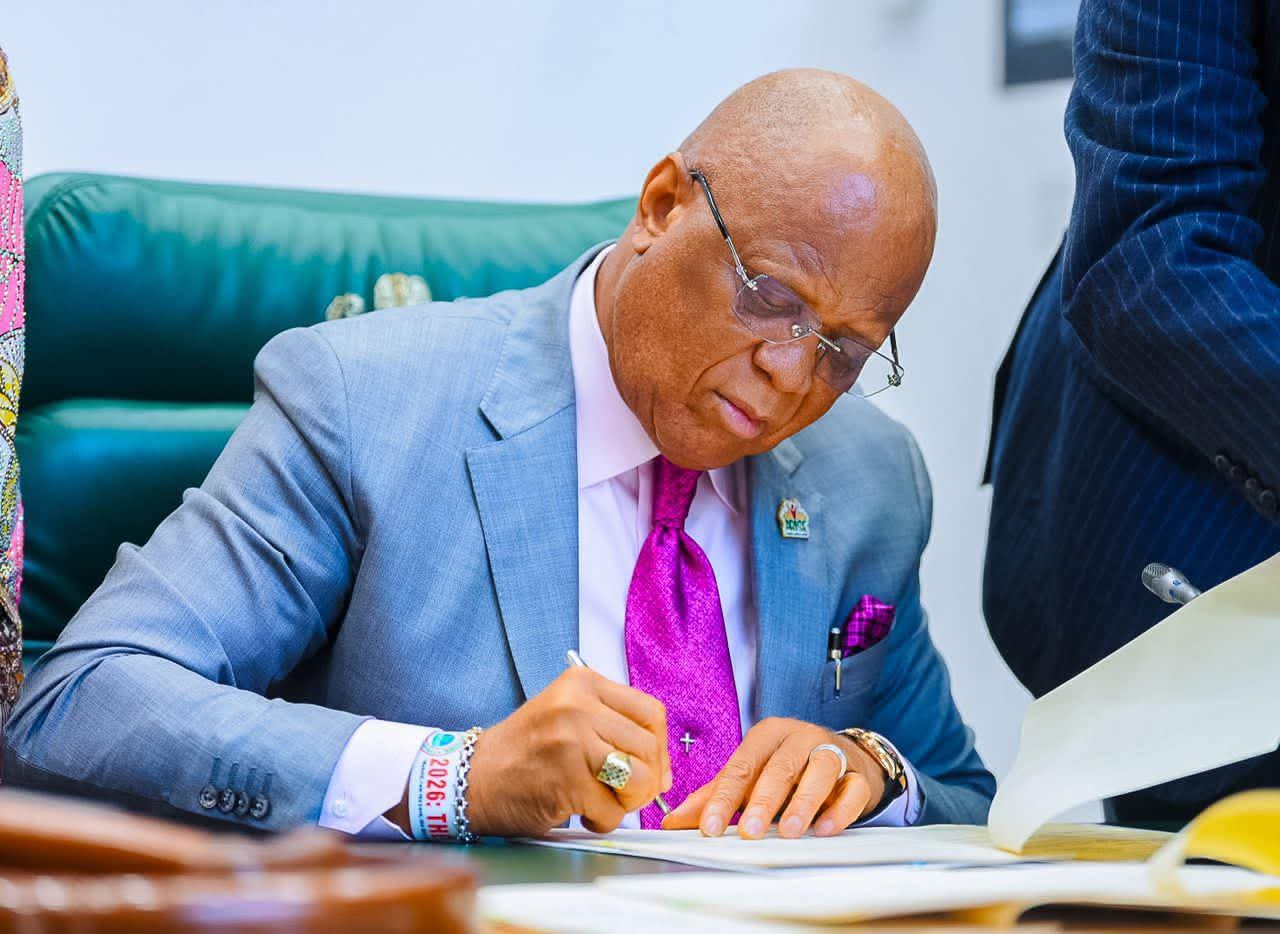

From a law on paper to lives on hospital beds, this report examines how Akwa Ibom’s health insurance experiment is unfolding and where it is already fraying.
By Ekemini Simon
For nearly four years, it existed largely as an idea trapped in the pages of a law gazette.
Passed by the Akwa Ibom State House of Assembly in June 2017, the law to establish the Akwa Ibom State Health Insurance Agency and Scheme was only signed in 2021 under the administration of Governor Udom Emmanuel. Even then, the law commencement date on October 30, 2021 did not translate into immediate relief for residents battered by out-of-pocket medical expenses. The agency remained mostly dormant; legally alive but operationally non-existent. A turnaround was urgently needed as many states of the federation were already enjoying universal health coverage.
While seeking office, Mr. Umo Eno identified the gap and made health insurance a core promise for the health sector in his ARISE Agenda, pledging to finally activate a scheme that would protect families from the financial shock of illness. 14 months after assuming office, his administration inaugurated the board of the Health Insurance Agency in July 2024. Two months later, on September 20, 2024, the state formally launched the Akwa Ibom State Health Insurance Scheme, codenamed ARISECare.
The launch was framed not just as a policy milestone, but as an intervention in a state deeply affected by multidimensional poverty causing illness to often mean selling land, withdrawing children from school, or choosing between drugs and food.
However, beyond the ceremony and slogan, what problem was ARISECare designed to solve and how far has it really gone?
Why health insurance matters in Akwa Ibom
In Akwa Ibom, as in much of Nigeria, healthcare financing has historically leaned heavily on out-of-pocket spending. For most families, especially those in rural settlements, and the informal sector medical bills are paid only when sickness strikes, often at monumental cost and calamitous price.
Interestingly, the Health Insurance Law of Akwa Ibom State attempts to reverse this reality.
Section 2 of the law outlines four broad objectives of the Scheme: to improve and harness private sector participation in healthcare delivery; to ensure appropriate patronage at all levels of the healthcare system; to guarantee the availability of funds for improved services; and, crucially, to ensure that where medical services are absent or inadequate, the state plans and develops healthcare services commensurate with residents’ needs, in collaboration with relevant organisations.
Beyond that, the law is also expansive in its reach. Section 3 makes clear that the scheme is not restricted to indigenes. It applies to all residents of Akwa Ibom State, across formal and informal sectors, including corporate organisations with offices or operational presence in the state. This implies that a non-indigene trader at mechanic village , a fisherman in Oron, a civil servant at the State Secretariat and an oil company employee in the state oil communities are all meant to be part of the same risk pool. No individual is exempted.
What is more, dependents too are covered recognising that illness rarely affects individuals in isolation, but households.
What the Agency is meant to achieve
Section 21 of the law spells out the objectives of the Akwa Ibom State Health Insurance Agency in clear, people-centred terms: ensuring every resident has access to quality healthcare; protecting families from the hardship of huge medical bills; controlling the rising cost of healthcare; and distributing healthcare costs equitably across income groups.
It also mandates the Agency to maintain high standards of care, ensure efficiency in service delivery, and stimulate private sector participation, while guaranteeing that primary, secondary and tertiary facilities all receive fair patronage.
This points to the fact that Akwa Ibom State Health Insurance was designed as both a social protection mechanism and a health system reform tool.
What the Scheme actually covers
For many residents, the most immediate question would be: what will this card get me at the hospital?
Section 38 of the law provides a detailed answer suggesting a package broad enough to address everyday illnesses and major life events where families are most financially vulnerable.
The benefit package includes defined curative care; prescribed drugs and diagnostic tests; maternity care for up to four live births per insured person; preventive services such as immunisation, family planning, and ante-natal and postnatal care; consultations across a defined range of specialties; hospital care in standard wards for physical or mental disorders; eye examinations including low-cost spectacles (excluding contact lenses); and a defined range of prosthetics and dental care.
The numbers: signs of momentum
Governor Umo Eno’s administration has taken steps that show the scheme is no longer theoretical.
Speaking during a sector-wide review and annual performance assessment of the Ministry of Health, the Commissioner for Health, Dr. Ekem Emmanuel, described the Akwa Ibom State Health Insurance Scheme as the fastest growing insurance scheme in Nigeria.

According to him, about 170,000 lives are currently covered. This includes 29,000 civil servants enrolled out of an estimated workforce of 52,000, alongside 78,000 dependants comprising spouses and children, and 68 retired permanent secretaries. All inmates in the state’s four correctional centres have also been enrolled.
The State government has included the society’s most invisible populations. The Commissioner said since registration began in April 2024, over 5,000 motherless babies have been captured under the scheme, more than 53,000 vulnerable persons including pregnant women, children under five, the elderly, and persons living with disabilities are receiving care at no cost.
Enrolment, Dr. Emmanuel explained, guarantees access to services through health insurance cards presented at accredited facilities after verification.
Utilisation data reeled out by the Commissioner suggests growing acceptance. According to him, in 2025 alone, there were 481,000 service utilisations under the scheme: 126,000 consultations, 1,106 surgeries, 1,012 vaginal deliveries, and 489 caesarean sections, with C-sections accounting for 32.5 per cent of total deliveries.
The Agency is also looking ahead. Plans are underway to launch the Tertiary Institutions Social Health Insurance Programme (TISHIP) statewide this year, bringing university, polytechnic and college students into the coverage net.
Following the Money on who is Paying
Healthcare insurance schemes rise or fall on sustainable financing and this is where the Akwa Ibom law is both ambitious and unsettling for some
Section 29 provides 12 separate funding sources, ranging from take-off grants by the state government and one percent of consolidated revenue or five percent of internally generated revenue from the state government, formal and informal sector contributions, and an equity fund drawn from one percent of consolidated revenue or five percent of internally generated revenue of the State Government, one percent of consolidated revenue of all Local Government Councils in the State and donations, NHIS funds, fines, investment dividends.
Others are one percent of annual constituency allowances of members of State House of Assembly meant for constituency projects and one percent of contract sum for contracts of fifty million naira and above State Government and fifteen million naira and above for Local Governments respectıvely.


On paper, the plan is a robust funding architecture designed to spread responsibility across government tiers, employers, individuals, and even legislators.
In practice however, compliance has left more to be desired and raised questions about government sustainability plans.
Dr. Emmanuel confirmed that the state government provided a take-off gant though he did not disclose the amount and supplied official vehicles to the Agency. He said the government is also meeting its equity funding obligations.
Local governments, however, are lagging behind. According to him, councils have not complied with their statutory contributions. The Commissioner said the Association of Local Governments of Nigeria (ALGON) in the state promised to enrol 1,000 persons per local government area but that commitment has yet to materialise.
Other deductions stipulated by law such as percentages from large contracts and constituency allowances from legislators are, by the Commissioner’s admission, likely not being fully implemented.
The Executive Secretary of the Akwa Ibom State Health Insurance Agency, Dr. Igbemi Arthur said the Agency has commenced engagement with the legislators and contractors for the fulfillment of their obligations. He assured there are positive responses and commitments.
Arthur said “For the state legislators, the Chairman House Committee on Health has been on it. He has even taken us to his constituency to enroll some of his constituents. He has paid his own and others will join as they have started reaching out to us.
“The State Government is working on it. The Governor has done something close to that and we will build on it. He paid for all 10,000 Junior Civil Servants for a year. Their money was not deducted. We have started engaging the companies. We hope to improve. ”
Regardless, this gap and development raise uncomfortable questions: can the scheme remain financially sustainable if key funding streams exist only on paper? And how long can the state government carry the burden alone?
Cost, access, and public trust
For individuals, the contribution structure is straightforward. Those in the informal sector pay N18,000 per year, while civil servants contribute five per cent of their basic salary, covering themselves, their spouses, and up to four children. Vulnerable groups are enrolled free of charge.
In 2025, capitation payments totalled N443.95 million, with N319.19 million going to primary healthcare facilities through the Basic Healthcare Provision Fund and N124.76 million to secondary facilities; N53.16 million to public hospitals and N71.6 million to private ones. Fee-for-service payments added another layer: N147.02 million for vulnerable groups, N79.33 million for the formal sector, and N9.27 million for the public sector. Altogether, healthcare expenditure under the scheme in 2025 stood at N679.57 million.
Yet numbers alone do not guarantee public confidence. Few complaints exist about delays, facility readiness, and understanding of benefits. Dr. Emmanuel said the Agency has updated its website and information platforms and is intensifying awareness campaigns through radio, print media, traditional institutions, and community structures. including monitoring of services provided. Offices are being established in all 10 federal constituencies, and enrolment forms distributed to primary healthcare centres statewide.
Promise still being tested
While ARISECare by the Umo Eno administration has moved Akwa Ibom from legislative intention to measurable action with hundreds of thousands of consultations, thousands of births, surgeries, and lives touched suggesting real progress yet the scheme’s future hinges on enforcement of the very law that created it.
Experts posit that until all funding provisions are complied with especially by State Government on clear and verifiable annual contribution, by local governments, political actors and contractors, the risk remains that ARISECare could become another reform sustained by goodwill rather than law.
Data of progress made in comparison with what the law designs show that the scheme stands as both a commendable milestone and a test of political will, fiscal discipline, and the state’s commitment to ensuring that falling ill no longer means falling into poverty.