


Inside Spaces for Change’s Quiet Revolution: Rewriting Power, Inclusion, Justice in Niger Delta Host Communities


By Ekemini Simon
On a warm Friday morning of November 14, 2025 in Uyo, long before the sun began its gentle descent toward the blue skyline of Akwa Ibom, something powerful, deeply symbolic and historic unfolded quietly.
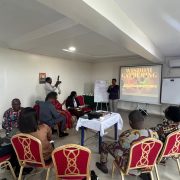
Inside the training hall of Rosmohr hotel, community leaders, members of Host Communities Development Trusts and civil society actors across Niger Delta States gathered not simply to listen, but to confront a story older than oil itself. This is the story of exclusion, power, and the people who live closest to Nigeria’s extractive wealth yet remain far off from its benefits.
It was the Gender Equality, Disability and Social Inclusion (GEDSI) Training for Host Community Leaders supported by the Ford Foundation and convened by Spaces for Change (S4C), a non-profit organisation working to infuse human rights into social and economic governance processes in Nigeria. For many in attendance, it was more than training. It was a mirror held up to the Niger Delta’s past, and a torch light beaming its future.
Gathering for a turning Point
The Executive Director of Spaces for Change, Victoria Ibezim-Ohaeri was not physically present, yet her words delivered with conviction by S4C’s Program Associate for Energy and Extractive Justice, Ms. Oluwatosin Akinjiola graced the room with an almost spiritual urgency.
Although welcoming guests to a programme, she spoke like someone handing over the blueprints of a new society “Today, we gather not merely for another training session, but for an important conversation about power, equity, and transformation… about who gets included when development decisions are made, whose voice counts, and whose future is being imagined.”
Through her words, everyone in the room heard echoes of their own unspoken truths. The Niger Delta has been the engine of Nigeria’s extractive economy even though its people carry scars invisible to outsiders, etched into daily life like poisoned rivers, ruined farmlands, lost livelihoods, and communities left to negotiate survival in the shadows of multibillion-dollar operations.
Interestingly, what she harped on was not only on loss. It was on the quiet defiance and brilliance that has survived despite it. “Within these communities, we find extraordinary resilience, women leading change at the grassroots, youth innovating for sustainability, and persons with disabilities refusing to be invisible.”
Something shifted in the room. Leaders who had arrived with folded arms now leaned forward. This was no longer a theory. It was a reckoning.
Goodwill Messages Became Testimonies
One after another, traditional leaders and community representatives rose to speak not with ceremonial commendation, but with an honesty shaped by lived struggle.
The Secretary of Levachiel Clans Council of Chiefs and Chair of the Extractives Management Committee in Cross River, Chief John Inyang termed the training as a rescue mission. “The Niger Delta is rich, yet burdened by inequality and exclusion. This platform strengthens our voices so development benefits are shared across gender, ability, and social lines”, he said.
The words of the Ruler, Elebele Community, His Royal Highness, David Osene touched hearts “If we don’t speak out for others, one day, we may be the victims. United we stand; together we fall.” It was not just a warning; it was an indictment of years of silence that allowed exclusion to multiply.

Then came perhaps the most jarring intervention from Delta State, through the voice of Chief Raphael Bright: “Some communities are not aware of the provisions of the PIA. Many have not set up their Trust. Some companies hide under the law to deny communities their benefits.”
His voice cut to the heart of the issue: The Petroleum Industry Act (PIA), celebrated as a turning point, has been weaponized in some places not as a pathway to empowerment, but as an excuse for withdrawal of responsibility.
CSR requests now meet a new refrain: “Refer to your HCDT.” Except some communities don’t even have one. And the circle of exclusion widens.
Birthing Accountability through GEDSI
The sessions that followed turned the hall into a laboratory of truth telling. The Executive Director of Ogechi & Sam Ikeh Foundation, Ogechi Ikeh broke down GEDSI in a way that stripped away jargon and exposed the raw inequities embedded in resource governance. She said this means Oil spills, gas flaring, but no compensation, women, youth, and persons with disabilities routinely left out of decisions, companies and communities locked in cycles of mistrust, and governance structures that reward the loudest, richest, and most connected.
And then she delivered the line that would under-pin the entire event: “GEDSI is fairness + inclusion + shared progress.”
Her message was simple but thought provoking. Ikeh said a Host Community Development Trust (HCDT) that excludes anyone is not a development mechanism, it is a gatekeeping tool.
Representation, participation, and equitable benefit sharing, she argued, are not favours. They are right and where they are absent, conflict becomes inevitable.
The Dimension of Mental Wellness through Inclusion
The presentation of the Country Director of Secure-D-Secure International Initiative, Dr. Chinaemerem Iwuanyanwu introduced a rarely discussed dimension of extraction; mental health.
Her session peeled back a layer many never talk about; the emotional weight of living in an environment where land, livelihoods, and the future feel uncertain.
She revealed stark numbers: Nigeria has only 0.15 psychiatrists per 100,000 people, 80–85 percent of people with severe mental disorders receive no treatment, Persons with Disabilities (PWDs) face double the risk of depression, Gender Based Violence (GBV) is rising, driving anxiety and trauma across genders and extractive communities suffer disproportionately from stress and insecurity.
Her message was sobering “Without GEDSI, Nigeria’s mental health systems risk excluding the very groups most affected by trauma.”
Leadership Reimagined
When the Strategy Leader and Governance Consultant, John Onyeukwu took the floor, he connected the dots between leadership and inclusion.

Leadership, he argued, is not charisma or authority rather it is intentional diversity. He warned against the comfort of tokenism where a woman or youth is “included” only to rubber-stamp decisions made elsewhere.
Inclusive leadership, he explained, requires not just inviting voices but removing the barriers that silence them and building systems that rely on fairness, not seniority or wealth. Leadership must evolve. Communities cannot progress on structures built on exclusion.” he said.
The Challenge of Naming the Problem
Policy Alert’s Executive Director, TIjah Bolton-Akpan, delivered one of the most defining sessions of the day.
He walked participants through the PIA, its promises, gaps, and loopholes. Then he made a statement that felt like a revelation. “Women are not the only ones excluded. Minority groups, the elderly, youth, PWDs, the poor, they are all left out too.”
In one sentence, he expanded the GEDSI conversation from gender alone to the full spectrum of marginalisation.
He warned that the HCDT is not magic.
“The Trust is not a silver bullet. We still need the government and companies to fulfill their mandates.”
The room nodded slowly, collectively. He had said what many had long suspected but rarely voiced. Bolton-Akpan said why gender and social Inclusion matters is that it
ensures equitable distribution of HCDT benefits, strengthens transparency and accountability, reduces conflict and improves legitimacy and addresses historical exclusion of women, youth, PwDs
Policy Alert Executive Director said already he Nigerian Upstream Petroleum Regulatory Commission (NUPRC) HCDT regulations provides in section 12(4) demands that require inclusive community consultation towards guiding
equitable Community Development Plan development; mandates transparent reporting and documentation; enable gender-disaggregated monitoring
He said the NUPRC Host Community Implementation Guidelines in section 10 (1,4)
provides for GESI in BOT selection and composition.
Bolton-Akpan went further to put forward Gender Indicators for analysing HCDTS to include: Women’s representation in governance, participation in Community Needs Assessment and Community Development Plan consultations, women-led access to procurement, benefit-sharing and access to resources and gender-sensitive grievance processes.
As leaders of the various Niger Delta communities return home, will they put into practice the new learnings in rewriting power, inclusion, justice in Niger Delta Host communities? The result lies in the actions and impact experienced across various HCDTs in months to come.